As printed in
the Electronic Sound magazine, 2022 this is JMJs account of recording La Cage and Erosmachine at the GRM:
‘La Cage’ and ‘Erosmachine’, the two tracks featured on Jean-Michel Jarre’s 1971 debut single, were both recorded a couple of years before the seven-inch was released. At the time, he was studying at the Groupe de Recherches Musicales (GRM), the electroacoustic music laboratory in Paris headed by musique concréte pioneer Pierre Schaeffer. Jarre put together the main components of ‘La Cage’ at the GRM in the dead of night, with a friend acting as a lookout.
“As students, we were not allowed to go alone into the big professional studios,” he remembers. “They were kept locked and only the established composers could use them, but we managed to make a copy of the key so we were able to get inside the studios at night. I did most of ‘La Cage’ in the dark, including the sequences, because we didn’t dare turn a light on.”
The GRM's close association with the Office de Radiodiffusion-Télévision Francaise (ORTF, previously known as RTF), which was responsible for French national radio and television, gave its tutors and students access to a wide array of broadcasting equipment, most notably the station's oscillators. Jarre used at least 12 oscillators for the intensely rhythmic together with a musical saw, a guitar which he played with of percussive instruments, including rototoms.
“Working with oscillators and filter banks that had been hijacked from the radio station was a totally underground approach,” laughs Jarre. “The radio had been using oscillators for testing and maintenance before this, not for making any kind of music. Using them to make sequences in this way was really interesting and the result is something that sounds very electronic.”
Jarre took a quite different path for ‘Erosmachine’, a much more playful electroacoustic track featuring sampled voices and a harmonium he came across in the studio. The sampling is one of the aspects that links his first single with ‘Oxymore’, his new album, and also with his mid-1980s releases ‘Zoolook’ and ‘Musique Pour Supermarché’.
“By sampling people shouting and breathing, I was being faithful to how we were dealing with sounds at the GRM,” he says. “The core of music as an art form is not just songs, so I’ve always believed vocals could be explored and exploited in ways that don’t involve lyrics. The whole idea of ‘Oxymore’ was about me going back to how I worked during this period, so the fact that this single is coming out again is something special.”
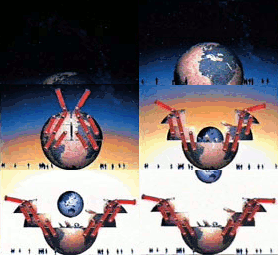
The ‘La Cage’/‘Erosmachine’ single came out on the Pathé label, at that point a division of EMI, and was available only in France. The often repeated story that only 117 copies were sold is almost certainly a myth, but itis unlikely the true figure was above 1,000. Which is why mint condition discs typically sell for around £200 and why we're delighted to be reissuing this record for the first time ever. Our reissue comes with a reconstruction of the original picture sleeve, the back of which boasts a wonderfully poetic paragraph written by Jarre’s childhood friend Max Dumas (credited as Xam Samud), describing Jarre crafting the tracks in the darkness of the GRM.
“Organ, bass guitar, drums in full force,” reads the text in English. “Lots of sticks. A whole range of percussion equipment, from the bongo to the rattle, including the flexatone and the wooden spoon. Finally, music. Mixed, ground, modulated by synthesiser, generators, filters themselves manipulated and monitored thanks to about 50 potentiometers and dials. The troglodyte magician fresh out of the ORTF’s Groupe de Recherches Musicales is there, reigning in his dark cave in the very centre of Paris. He touches everything, sees everything. The sound gushes out from the powerful speakers.”