Interviewer: [Your have] always been an advocate for new technology. You have been helping conceiving instruments, and you embrace the synthesizer as the SDI revolution, it was back then. Isn't it a bit weird that you're now celebrating old equipment?
JMJ: It's a very interesting point indeed, I've always been involved, as you said, with and interested by new technology, because it's part of the music electronic world. But at the same time, the methodology of electronic music, the foundations are coming from very special instruments that have been devised, designed, let's say, between the 1920s and the 1970s. And they suddenly disappeared because of the explosion of the digital era, the computer world without being popular, in a sense. So it's not an act of nostalgia at all to play with those instruments. But it's actually I think, I do think I'm convinced that they have these instruments alive, a life in front of us ahead of us. It means that and also in music, there is something very special. For instance, if you take classical music, the dream of any violin player in the world in 2008, is to play on a Stradivarius, an instrument that has been, a violin that has been devised for centuries ago. And you think that since the vast past four centuries, nobody has succeeded to beat in terms of quality and warmth. That instrument it proves that time technological progress has nothing to do sometimes in in with musical instruments. And sometimes people have secrets or special new house that you cannot replace.
And it's exactly this the thing for these analog instruments, plus the fact that actually these days because of that because of the disparition electronic music He's almost often of its roots. And you can see that in lots all software's for music, on computers these days are imitating or emulating analog instruments even going to reproduce the facades, the look of them. And then you have to, to move the knobs in in a rather awkward way with your mouse, why not using the real ones, it's a little bit like if you were trying to play Gibson, Gibson, electric guitar or fender or violin through your, your screen, the screen of your Mac, it would be inconceivable. It's exactly the same with those instruments, they have a special warmth, a special texture that can be replaced, you can do lots of other things very exciting with the computer, but not that. And actually I rediscovered that myself, because frankly, I almost forgot those instruments also with through the years, and slowly to get them back in the studio to rerecord this piece gave me the desire to share this experience in a more proximity situation onstage and to invite the people in my kitchen in a sense.
Electronic music needs to create the link with its origins, what has not been done yet. So electronic music has a big future by just simply recognize what, what, from where it's coming from all that. And it's, as you said, Very truly, people are now all electronic musicians. They're all fantasizing dreaming about those instruments, but you can't get them anymore. So I know that a tool like that, I'm sure is going to help a lot, even people to re-manufacture those instruments because it's possible to do that. It's not easy, but it's it's possible like anything if you decided in life, I mean, tomorrow you can can decide to to launch a new range of analog instrument, but it's time now to leave this kind of a virtual vortex in which we've been trapped the past 20 years. And, and also, I always considered electronic music not as abstract not as robotic, not as dehumanized, not as cold, as it has been said so much. But exactly the reverse. It's like cooking, having fun. Doing electronic music is like mixing ingredients, textures, colors, with your fingers in a tactile sensual, organic way. And I don't think that you can do that with computers. You can do other things with computers. No, it's like, for me having met an old friend, I lost in the street by chance. And suddenly I said Okay, this time we're not going going to spend another 10 years or 15 years without seeing each other. So it means in other words that I really want to to keep these instruments as the center the heart of my future creations and compositions because I truly think as I said, this is the way where we should go do.
Oxygene Part One has been done actually after Oxygene part two. I was quite interested at that time in as a composition composition process, not to start by the beginning but but to start by the middle of the piece. And it's an advice I would give to young composers because it forces you to be very imaginative to start with something that matches what you have done. It's like in George Lucas Star Wars when he did the first three after the beginning after the middle and and it's it starts really probably as the most classical form in classical music sense of the word of my work. It's really made of strings and bass based on the instrument very important to me called the Eminent and it's the probably the best string ensemble synthesizer you can find So it has a very warm, warm sound. And it has a very old, Oxygene Part one is developing like a kind of electronic symphony or concert to where you have no beats. And actually on stage, we have to we at the beginning, not anymore now because we know the peace, but we had to use score like, like orchestral scores because you have to, almost to, to play together to have a conductor being able to play all together because you don't have bass drums or or kicks or drum machines to keep the tempo. So it's a kind of free free format. It has to be played like that, to actually to keep the quality aspect of it
Oxygene part two has been the first part of I've done from Oxygene and I was quite obsessed at that at that moment to play as almost a reaction about German music such as Kraftwerk and Tangerine Dream. These guys were were the brilliant way actually having a very cold does humanize robotic approach of electronic world and I was absolutely the opposite and I wanted to prove to make my point with Oxygene on that. So, Oxygene 2 has this kind of repetition of baseline and some sequences but everything is done by hands. There is no patterns, no repetition and if you listen to that carefully, new sounds are automatically the same they all the old specific they're all tailor made instant by instant and then it has that kind of evolution. A real analog evolution like in life. I wanted something that could match the accidents and the the always different moods you have day after day. Every day in Oslo is more or less the same but it's also more or less different. And it's exactly what he had in mind for the for Oxygene part 2.
Oxygene part three is the most dramatic part of the of the whole Oxygene I was quite influenced at that time by by 2001 Space Odyssey the this kind of dramatic journey to the universe and having these kind of strange clusters dissonance of, of sounds that I use the eminent in to do these kind of clusters. A cluster in music is a group of nodes that are not necessarily made to play to each other. It's like like a big noise where you play all notes on the keyboard at the same time with your arms and that is what I've done by having these strange glissandos and all that and also playing like in part one, this this kind of vocal part, almost like a soprano voice by the first synthesizer I got in my life called the AKS. It's the first European synthesizer devised by and by an English by some English engineers and you have that kind of almost operatic type of mood that these days I'm playing the sport with the terramin the theremin is the Russian instruments quite strange and quite interesting working with radio waves and it's more difficult to control but it's quite interesting for the live version.
And then we go to maybe what became the anthem of the album Oxygene for what actually I compose really in one night in a rather unconscious way was not for me supposed to be a single or to be hit or whatever I just wanted to have that kind of pace like you are like you're in a journey in the road after this kind of more more or less ethereal mood of the of the first three parts I wanted to have that kind of that kind of something going ahead and being like when you are on the highway in your car.
Part five is an interesting piece in the construction because it has two different sub parts one is very slow and and played almost as the solo part is probably the most minimalist part of the of the album at the beginning because there is only one eminent again but processed with a very special Flanger effect that gives these harmonics that are like like notes like bubbles. And if and this evolution there is an evolution until real Apogee at about that has been done with the only arpeggiator available at that moment called the MMI. And it's a stereo instruments where where the nddc only moment on the album I could sync really two sequences at the same time because all the other sequences I said are made with by hands and I had the opportunity so I use it to get this arpeggiators with to two outputs and that the the two sequences of Part Five with the base sequence and the noise percussion sequence
Part six is probably the most prefiguration of all what lounge music became kind of ambient music very figurative where with all these waves and bird sounds that are it's like I like in your, in your memory, in your souvenirs when you are when you when you see for instance the photo of your holidays and it carries lots of sounds, music words and all that. So this piece of music is like if the ocean was carrying the piece of music in a sense and what I liked in this in this piece and what I like in this piece is actually it's not just the waves I recorded, but I recreated the waves and it's reminds me about what Federico Fellini the Italian famous Italian film director said once he said I hate Sea and the beach and ocean I if I want to shoot the sea I want to recreate it in studio with fans paintings and drapes and people moving drapes and all that because that will be the idea of the see this the way I see it in my dreams and not just the rigorous and I like very much this analogy because for Oxygene six is exactly what I had in mind.
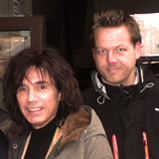


 nice he explains Oxygene track by track.